Solutions
Network IntegrationIoTMobileSmall BusinessSignal
Products
SherwoodOSSherwood PlusSherwoodAICarrier EnablementWi-Fi ToolkitWOXPremium Support
Network
Network at a GlanceSHW TokenGovernance ProposalSimple RewardsGlobal Expansion
Resources
BlogDownloadsSherwood AppTrade-UpContact
Vote Has Passed The community has spoken

The wireless industry is breaking.
Sherwood is the repair.

Sherwood started with IoT and the idea of The People's Network in 2019. That model proved a decentralized network, built and owned by its community, can actually work at scale. Today that same model carries real carrier traffic for millions of people every day.

The last two years brought real validation from carrier demand, but Sherwood's original economic framework hasn't kept up. This proposal fixes the economics for the long term, so the people who built this Network can reliably earn from the impact it's having on a 150-year-old industry.

This proposal has been refined through three weeks of community deliberation, including town halls, Discord engagement, and direct collaboration with community contributors who co-authored the governance framework.


A town the network reaches at dusk
Status: Advisory Council Members have been elected. Implementation underway · advisory council seated
Advisory Council

Advisory Council Election Vote Results.

Elected by veSHW holders in the SIP-149 Advisory Council Election. Voting closed Jul 20, 2026.

Marian Oak

Marian Oak

@marian.oak

Rowan Ash

Rowan Ash, MD

@rowan.ash

Tobias Wren

Tobias Wren

@tobias.wren

Elias March

Elias March

@elias.march

Cedric Holt

Cedric Holt

@cedric.holt

01

What You Missed.

The global wireless industry spends over $200 billion a year building network infrastructure, and that number is now declining while demand for coverage keeps climbing. Carriers need more capacity in more hard places — stadiums, transit hubs, dense indoor, underserved communities — with less capital to build it. No single company can close that gap alone.

Sherwood flips the model. Instead of one carrier funding every tower, thousands of independent deployers build coverage where demand actually is, own the infrastructure, and earn from the traffic that flows through it. This is telco's AWS moment: fixed capital expense converted into pay-per-use infrastructure.

Sherwood, ~2 years ago

  • ✕ Hotspots earned for providing coverage, whether or not anyone used it
  • ✕ IoT in active use, Mobile still in early pilots
  • ✕ Proving the model could work

Sherwood, Today

  • ✓ Carrier-grade wireless at scale, used by millions daily
  • ✓ Real carrier traffic across the US and Mexico, expanding internationally
  • ✓ An intelligent connectivity platform carriers are asking to build on
1.2M+
Hotspots across major airports, casinos, and city centers
2.4M+
Daily active users, sustained at scale
3.4TB
Carrier data routed every day
5x
Traffic surge absorbed during Big Game Weekend

Here is the part that matters for SHW holders: SHW is not a meme. It is an infrastructure share, a use-backed asset where verified carrier usage permanently burns SHW, and where the community that builds the Network governs its supply. The more the Network is used, the more SHW leaves circulation.

02

So Why a Proposal Now?

Sherwood's original economic framework was built for a faster carrier-adoption curve than reality delivered. That is not a failure to hide — it is the reason a clean correction is possible now: we finally have real data on how carriers actually adopt. Three pressures have built up, and this proposal resolves them in a single move.

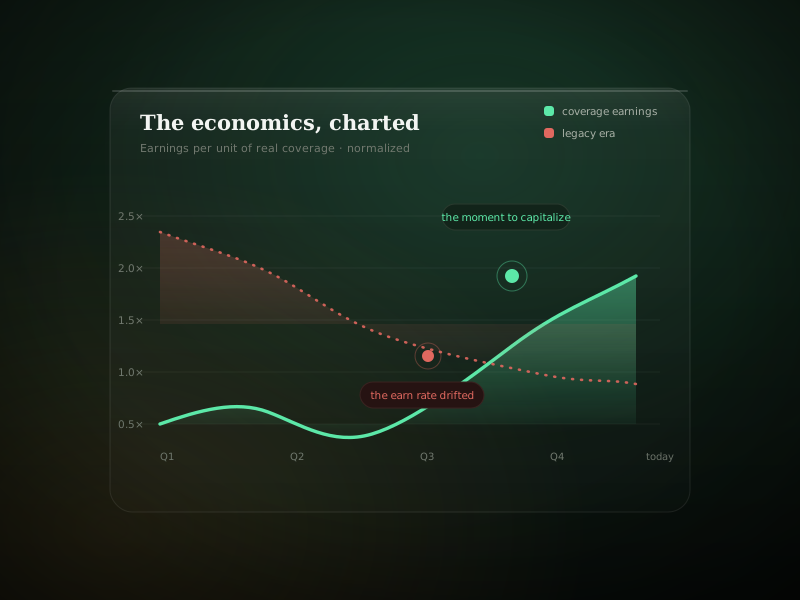
The earn rate drifted

The earn rate drifted

The protocol rate of $0.50/GB was unsustainable based on carrier paid rates: traffic grew about 5x, SHW issuance stayed fixed, and the token price more than halved. Earnings need to anchor to what carriers actually pay, not an outdated target.

Proof of Coverage did its job

Proof of Coverage did its job

PoC was the tool that built coverage before any demand existed, and it worked. Now that real traffic is here, paying Hotspots for simply existing diverts rewards from the deployers actually serving users. The bootstrap succeeded, so now the tool retires.

The moment to capitalize

The moment to capitalize

Carrier demand is proven. Reaching scale means funding international expansion and the intelligence platform now, while carriers shop for new models and Sherwood is the only one filling the gap. But today's emissions fund rewards, not growth. Every infrastructure company hits the moment where proven demand outruns its capital model. This is ours, and we close it with a finite, on-chain capitalization.

03

The Proposal, in Four Moves.

A deployer earnings floor
Move 1

A Deployer Earnings Floor

A safety net under deployer earnings

The problem: deployer earnings have been exposed to SHW price swings, with no guaranteed floor in dollars.

This fixes it. Deployers earn SHW worth at least 50% of what carriers actually pay, every epoch. If SHW falls far enough that normal rewards dip below that floor, the protocol tops them back up. When SHW rises, deployers earn more, up to 3x the carrier burn rate, which keeps the model sustainable while giving deployers meaningful room on the upside. Both the floor and the cap rise automatically as carrier rates improve.

That 50% is not a marketing number — it is the largest line in a fixed protocol split. Of every dollar a carrier pays: 50% to deployers, 30% to network operations, 14% to the council-held treasury, 6% to buyback and burn. The split is a protocol constant, published on-chain — only a further SIP can move it.

Earnings are a share of carrier demand, not a fixed slice of a pie. More adoption means more traffic flowing through the Network, which grows what deployers can earn.

Move 2

Capitalize Operations and Growth

Fuel to expand, on-chain and capped

A capped SHW mint into a public on-chain vault: one authorization, about 141M SHW, paid out over about 36 months and ending on its own. Yes, this increases SHW supply. It is finite and bounded.

Two reasons it is needed now. First, the Network has been subsidizing the gap between the protocol rate and what carriers commercially pay, and that subsidy is not sustainable. Second, reaching carrier scale takes capital that the fixed issuance schedule cannot provide. Demand is proven and now is the time to invest.

New issuance runs flat for the first 12 months, then tapers to zero over the following 24 months and stops on its own, no future vote required. The mint does not begin until two weeks after the Advisory Council is seated and has completed initial diligence. Every dollar funds Network growth: international carrier expansion, deployer programs, and the carrier platform. None of it flows to on-chain Hotspot rewards. Every outflow is visible on-chain in real time, overseen by the Community Advisory Council, and the community can vote to shut it off at any point.

Capitalize operations and growth
A Community Advisory Council
Move 3

A Community Advisory Council

Oversight and a kill switch

A 7-seat council provides real oversight on capitalization: 5 seats community-elected, 2 from Sherwood Labs. Sherwood Labs recuses its veSHW positions from voting on community seats. The Council receives 1.25% of the mint funding for independent legal counsel and operations.

The Council receives quarterly financial and operational disclosures. It can demand additional information, publish dissent, and trigger a community vote to reduce, pause, or halt the mint at any time. Sherwood Labs' two seats cannot trigger that vote, and cannot block it either.

This is more transparency than most public companies give shareholders.

Move 4

Retire Proof-of-Coverage

Earn for being useful

Hotspots stop earning just for being plugged in. They earn for carrying real carrier traffic.

This applies to both the Mobile and IoT networks. A 20% larger data pool flows immediately to the deployers actually serving users. The more useful a Hotspot, the more its deployer earns.

Retire Proof-of-Coverage
Sherwood's next era
04

What It Means If It Passes.

What changes with this Proposal

  • ✓ Deployers earn from real utility, with a dollar-anchored floor protecting the downside with a sustainable cap.
  • ✓ The Network gets capital to expand internationally and ship the carrier platform.
  • ✓ SHW reads more clearly as a use-backed asset: rewards track real demand, not an outdated target.
  • ✓ The community gains a standing oversight body with disclosure rights and a kill switch.
  • ✓ The model moves toward self-sustaining economics as carrier revenue scales.

What does NOT change with this Proposal

  • ✕ The halving schedule, preserved
  • ✕ veSHW lockups, multipliers, and voting
  • ✕ The 6% delegator allocation
  • ✕ The Data Credit burn mechanism
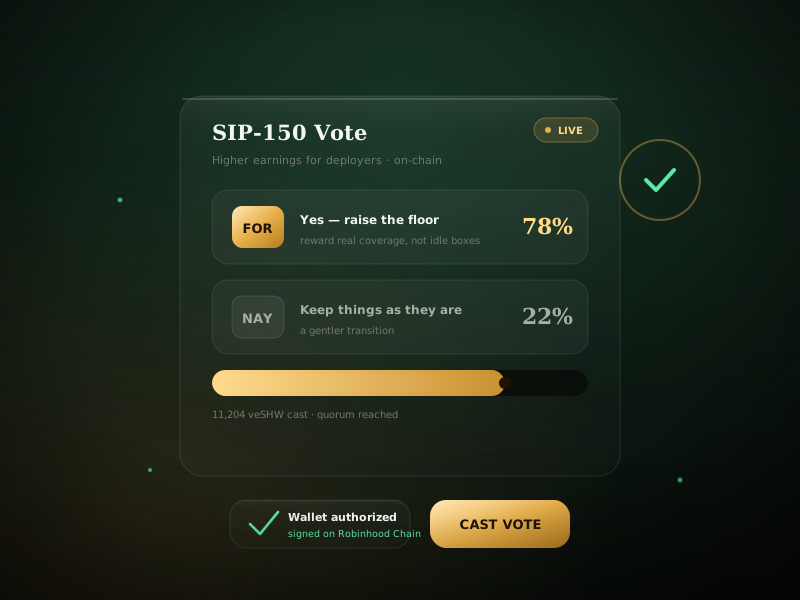
On-chain vote

Sherwood's Next Era Starts Now.

This proposal contains four significant changes which are being proposed in parallel because they all depend on each other. The council exists to oversee the capitalization, the floor protects deployers through growth, and utility rewards graduate Sherwood from proof to sustainability. Read the full proposal, challenge the assumptions, and bring the hard questions.

◈ Settled on the Robinhood Chain

Vote Has Passed!

Thank you to everyone who participated. This proposal is now moving into implementation.

The vote has closed and passed. On-chain records remain verifiable on the Robinhood Chain.